OSINT Digest from May 27, 2026: From Readiness to Logistics — NATO Builds Infrastructure

Breakdown: Force posture falls to 0.00, Logistics rises to 0.14 — marking a shift from reactions to strategic preparation, but the threat remains real
Overall Assessment for the Day (Composite Index)
Composite: 0.10 | Delta 6h: 0.00 | Delta 24h: 0.00
The index continues its gradual decline: from 0.11 yesterday to 0.10 today. This appears as a positive trend on the surface, yet the structure of component indices has shifted dramatically.
Force posture has fallen to 0.00 — meaning there is no state of maximum combat readiness. Systems are operating in routine mode.
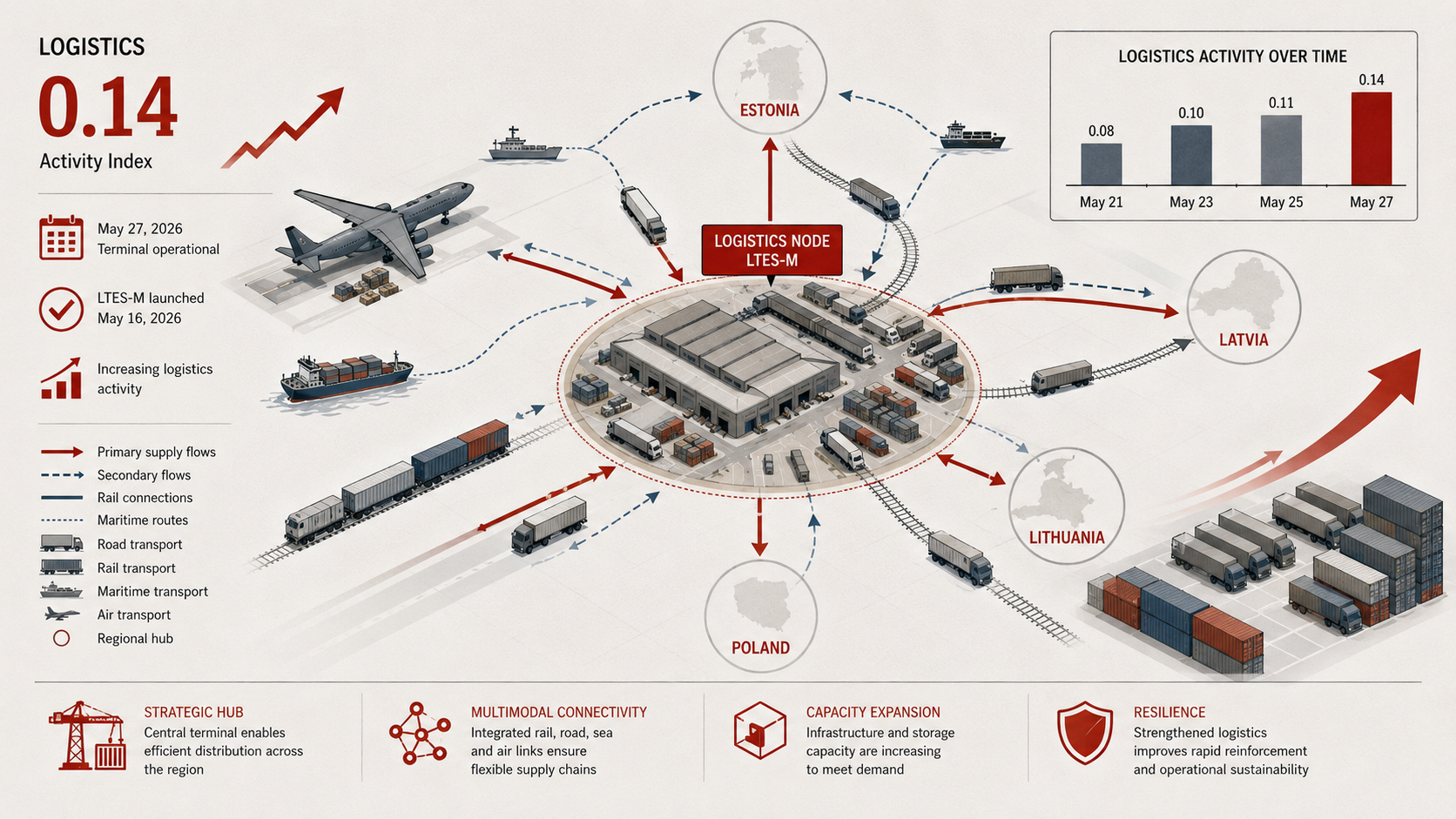
Logistics has risen to 0.14 — this is the news. Logistical activity has intensified, signaling strategic deployment rather than crisis response.
This signals a fundamental shift: NATO is transitioning from a phase of reactive readiness (which characterized May 23-26) to a phase of strategic construction.
Assessment Components
1. Military Posture (Force posture): 0.00
This is a sharp drop from 0.16 just one day ago. Yet this is good news, not a problem.
What this means:
When Force posture equals 0.00, it indicates:
- No state of emergency response
- Quick Reaction Alert systems are functioning in stable mode
- The French aviation flight at Šiauliai continues standard patrols without spikes in activity
- Drone pressure has subsided enough to allow transition to normal operations
This does not mean relaxation. It means the acute phase has passed and the system can focus on long-term preparation instead of constant daily incident response.
2. Logistics (Logistics): 0.14
This is the first significant rise in the logistics index since monitoring began. From 0.00 to 0.14 in a single day.
Reasons for the rise:
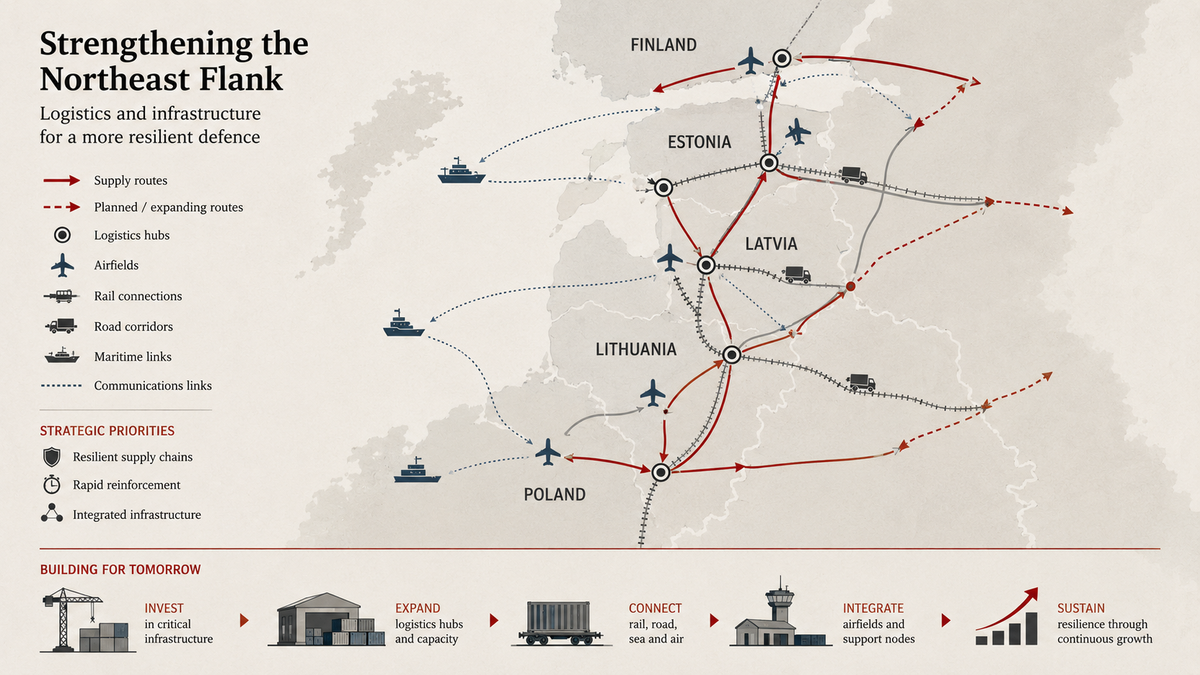
On May 27, one of NATO's largest and most strategically important logistical infrastructures on the northeastern flank was officially launched — the LTES-M logistics complex (Logistics Terminal Europe Site-Main) for deployment of U.S. materials and equipment.
Germany and the Netherlands plan to strengthen the eastern flank under NATO auspices, creating a new command structure for rapid troop deployment in Latvia and Estonia in the event of conflict.
At the Northern Europe defense conference, particular attention was devoted to operationalizing the enhanced defense line on NATO's Eastern Flank, coordination among Allied forces, military mobility, logistics, and alignment of regional defense plans.
0.14 indicates construction activity, not crisis activity. This is long-term infrastructure.
3. Information and Cyber (Info/Cyber): 0.13
Risen from 0.00 to 0.13 — new activity in the information space.
What's being discussed:
The Council on Geostrategy think tank warned that logistics operations across Europe will face greater challenges, including potential for strikes and sabotage. This could cut off resources from frontlines, leading to military collapse.
This is a fair observation. When logistics is being built, it becomes a target. The OSINT agent registers this as information activity.
Reports about possible U.S. reduction in the number of troops it can deploy to Europe in case of conflict.
This creates some information noise — debate about whether American presence is sufficient. Yet this noise does not affect actual operations.
4. Borders/Air/Maritime (Border/Air/Maritime): 0.18
The index has fallen from 0.21 to 0.18, but this number is misleading in the current context.
What this means and what it doesn't:
The frequency of drone incidents at borders has decreased (hence the index fell). But this does not mean the threat has vanished or become safer.
On May 27, a Russian drone struck a residential building in Galați, Romania (a NATO member), damaging the structure and triggering discussions about possible invocation of Article 5. This represents an escalation in character of the threat, not a decline in seriousness.
Drones now arrive less frequently than in previous days, but when they do arrive — they strike civilian populations on NATO member territory.
Russian aviation activity remains in the normal range of continuous airspace violations.
SABER STRIKE 26 exercises continue in Finland — but this fact is no longer about reacting to drone intrusions, but rather about long-term regional preparation.
0.18 — this number shows that incident frequency has decreased, but when incidents occur, they have changed in character: no longer just peripheral drones at borders, but direct strikes against civilian infrastructure of NATO states.
Top 5 Events Analyzed by the Digest
| # | Event | Source | Attention Index |
|---|---|---|---|
| 1 | NATO Military Committee in Chiefs of Defence Session | NATO | 0.44 |
| 2 | French Rafales continue Baltic Air Policing | Allied Air Command | 0.41 |
| 3 | Joint NATO press conference (Military Committee + SACEUR + SACT) | NATO | 0.38 |
| 4 | Military Committee in Chiefs of Defence Session (repeat) | NATO | 0.38 |
| 5 | Frigate FS Bretagne patrols the Baltic | NATO | 0.35 |
What NATO Has Built Over the Past 4 Days
Throughout May, the region's infrastructure development system has been accelerating:
May 23: Request for strengthening from regional states
May 25: Announcement of €12 billion in additional EU SAFE funding, deployment of 60,000 military personnel
May 26: Announcement of new command structures for rapid deployment
May 27: Launch of LTES-M logistics complex, central hub for American materiel
These are not random actions. This is a coordinated plan unfolding according to schedule.
Risks on the Horizon
GLOBSEC analysis shows that critical gaps persist: logistics, ammunition stockpiles, maintenance, and medical support remain major constraints across several regional countries.
Critical vulnerability: military mobility remains a weak link — infrastructure and legal obstacles continue to slow reinforcement across Europe.
These are objective problems requiring time to solve. NATO understands this and is working on solutions.
Difference Between May 26 and May 27
| Date | Composite | Force posture | Logistics | Info/Cyber | Border/Air/Maritime | Context |
|---|---|---|---|---|---|---|
| May 26 | 0.11 | 0.16 | 0.00 | 0.00 | 0.21 | Military readiness, drone activity declining |
| May 27 | 0.10 | 0.00 | 0.14 | 0.13 | 0.18 | Shift to logistics construction, but Galați incident shows shift in threat character |
Good news: Force posture has fallen — no reason for escalation. Systems are transitioning to normal mode.
Important: Logistics has risen — this is strategic investment for years ahead.
Reality: Incident frequency is declining, but severity is rising. Drones now strike civilian areas of NATO members, not just border regions.
Conclusion: From Reaction to Construction, Under Shadow of New Reality
Over the past four days, NATO has transitioned from reactive readiness mode to strategic construction mode. Yet the Galați incident demonstrates that this construction is happening under a threat that has changed in character.
What this means:
- The acute phase of drone intrusions is subsiding (less frequent than before)
- But when drones do arrive, they no longer stop at borders
- NATO is building logistics and infrastructure, aware that it must account for more than just drone frequency — it must account for how they are changing civilian life
- The system is transitioning to long-term readiness rather than daily response
The Council on Geostrategy's warning about logistics risks is justified. Logistics can indeed become a bottleneck in case of conflict. But building it is exactly what NATO is doing today.
For people at the border, this means: the coming period will be about construction, exercises, and strengthening. But also about accepting the fact that Russian drones no longer merely breach the periphery — they reach civilian infrastructure. This is the new normal.
OSINT Digest: May 27, 2026, 13:42:57 UTC
Released: May 27, 2026
Events Analyzed: 10
High-Confidence Events: 0
Errors in 24h: 0
Source: Baltic Security Monitor, configured to track security in NATO's northeastern region