The Donbas Front and European Uncertainty: Two Theaters, One Strategic Choice


Analysis: Ukrainian success in drone warfare does not offset American uncertainty in European security
Situation on the Donetsk Direction
Combat activity on the northern section of the Donetsk front line remains intense. According to recent data:
- 291 combat engagements per day across various sectors
- 91 Russian airstrikes (bombing and missile attacks)
- 8,549 "kamikaze" drone attacks (explosive-equipped unmanned aircraft)
Ukrainian forces conducted counterattacks that locally disrupted Russian offensive operations. However, the situation around Oleksandrivka and along the Vovcha River remains tense, with continued Russian attempts to cross and expand their bridgehead.
Ukrainian Drone Strategy: From Tactics to Operations
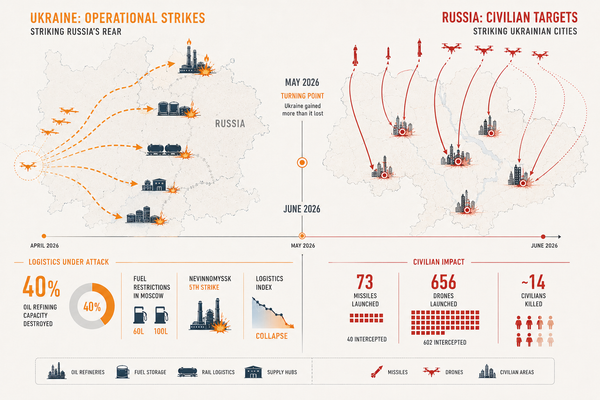
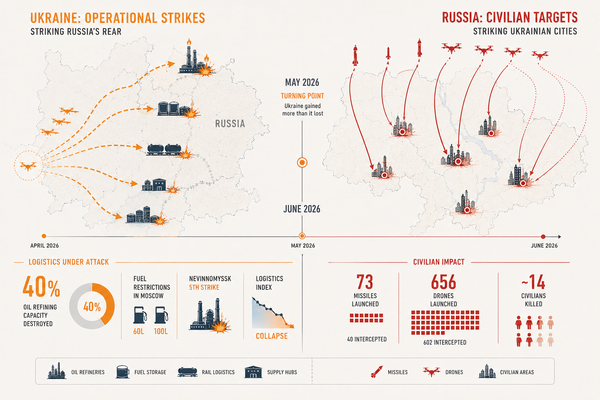
One of Ukraine's greatest achievements in recent months is the expansion of drone warfare from primarily local (near the front line) to operational depth (hundreds of kilometers into Russian territory).
What this means practically:
Ukrainian forces are disrupting Russian transport nodes hundreds of kilometers from the front line, demonstrating growing capability to conduct operational-level drone warfare
This changes conflict dynamics. Rather than direct frontal assault on positions, Ukraine is cutting Russian logistical chains. This is a less costly but more effective method of constraining Russian offensive capability.
Strategic Weight: Inexpensive drones can accomplish what traditional artillery achieves at far greater cost and slower pace. This is a lesson Europe must learn.
American Uncertainty as European Risk
Here begins the second, broader challenge.
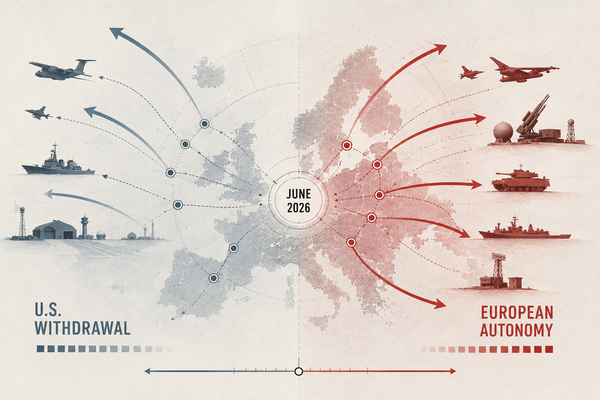
The Trump administration has announced gradual withdrawal of the United States from European security, creating uncertainty regarding American guarantees even in case of conflict.
This does not mean the U.S. is immediately leaving Europe. It means the guarantee is no longer automatic.
Why this matters for Europe:
Current European defensive strategy (particularly on NATO's northeastern flank) depends on American presence as a security cushion. If this umbrella becomes unreliable, then:
- More European troops needed on the ground
- Greater autonomy needed in weapons and ammunition supplies
- Rapid adaptation of doctrine to new realities needed
All of this requires time and money.
The Time Dimension: Strategic Vulnerability
The sharpest point in the anatomy of this crisis is the time gap.
Research from RAND Corporation (2016) and more recent military intelligence assessments show:
- 6 months — time Russia would need to reconstitute forces for a local operation (against one Baltic state)
- 2 years — time for a regional operation (joint attack on the northeastern NATO flank)
Estonia is calculating precisely on this timeline. Earlier (2016), it was assessed that Russia theoretically could capture Tallinn within 60 hours of invasion. But:
The current situation is different, and no scenario could succeed strategically, even with minimal American assistance
This means NATO on the northeastern flank is developing sufficient defensive capability. The problem is not defense capability but the timeline for when that defense becomes fully operational.
The Problem of European Combat Capability
Ukraine demonstrates that modern war can be conducted cheaply and effectively:
- Mass drone attacks instead of expensive cruise missiles
- Distributed production instead of centralized factories
- Adaptive tactics instead of rigid doctrines
But Europe should not learn these lessons through defeat. The problem is that the entire European defense base was built under an American security umbrella and against a Soviet-era threat. Hybrid warfare as Ukraine conducts it is a comparatively new reality for Europe.
Europe has not achieved the production capacity needed over four years of Ukrainian conflict
This means:
- Shortage of artillery ammunition (estimated in billions of rounds needed in case of large-scale conflict)
- Insufficient drone production (though some European countries are developing indigenous programs)
- Weakness in air defense systems at the level needed for drone warfare
The Strategic Game Until 2027
On the horizon stands 2027. This is not an arbitrary date but a strategic turning point:
- Current defensive programs (IRIS-T, NASAMS, new aviation systems) must be fully integrated on NATO's northeastern flank
- American presence will be reassessed in context of new administration and real costs
- Russian coalition will complete reformatting after exhausting human resources in Ukraine
This means decisions are made now, not later.
Europe as a Player: Three Possible Scenarios
Scenario 1: Reduced U.S. Dependence
If the U.S. directly reduces presence, Europe will attempt to compensate with its own forces. This is possible but costly and slow.
Scenario 2: French Nuclear Umbrella
France could extend its nuclear guarantee to NATO members. But:
Europe is divided between Macron and potential Le Pen on French positioning
Political uncertainty in France complicates this scenario.
Scenario 3: Strategic Autonomy
Europe invests in its own weapons, production, and doctrine. This is a long-term but most reliable path.
Conclusion: Kyiv as Laboratory for Europe
Ukraine is not just fighting — it is demonstrating how to conduct modern war with limited resources.
Each day on the front provides Europe with data:
- How to use drones cheaply and effectively
- How to sever adversary logistics
- How to adapt to minimal external support
But the game ends in 2027, when the American umbrella will de facto be unavailable
For Europe, the critical question is: will it learn Kyiv's lessons before 2027, or will it implement them under pressure of its own crisis?
Without radical reorientation toward its own production and strategic autonomy, Europe risks a situation where knowledge exists but time for implementation does not.
Date: June 1, 2026
Source: Combat reports analysis, OSINT monitoring, RAND Corporation assessments