A Day Without a New Number: When the Pipeline Goes Quiet, Logistics Still Leads

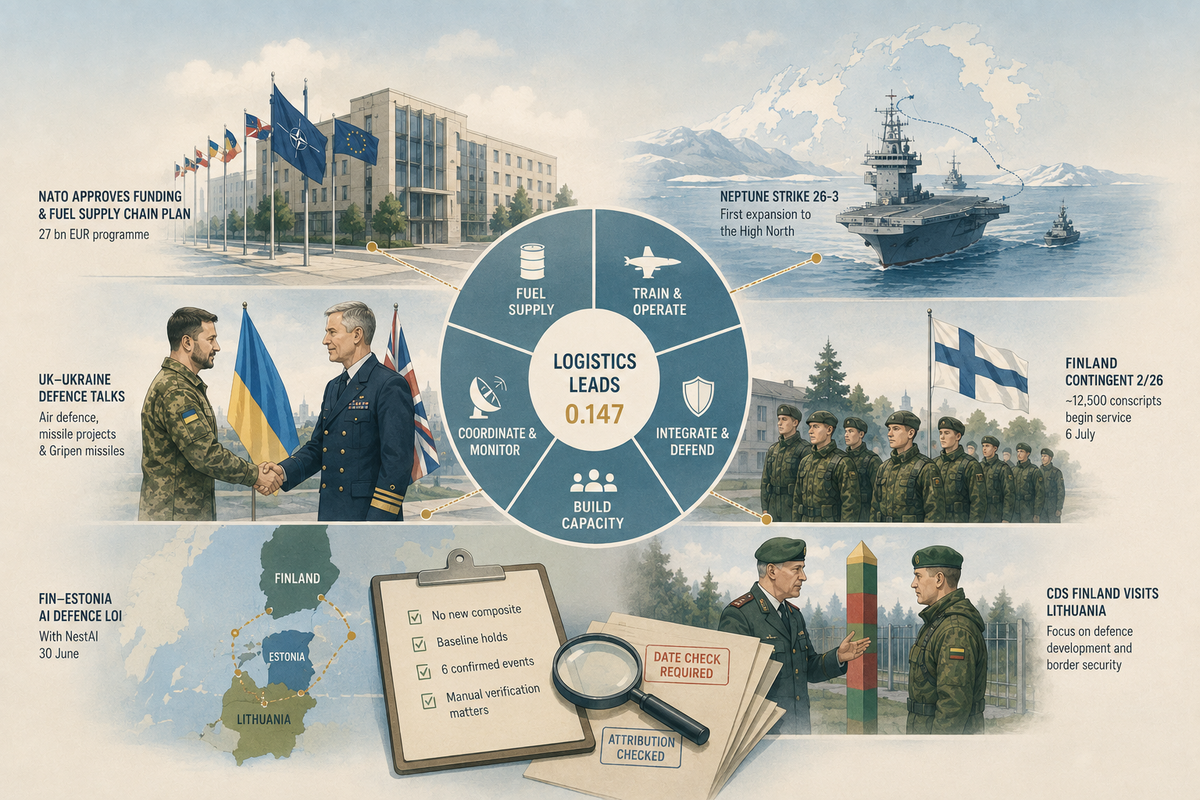
Baltic Security Monitor | Qualitative Review (WF3 blocked by quota) Period: 24 hours to 3 August 2026
Today there is no new Composite figure — only the 31 July baseline and six confirmed institutional events, none of them urgent. This is a rare day when BSM says plainly: our quantitative pipeline is silent, and we are reading the picture qualitatively, by hand. That does not weaken the conclusion — if anything, the manual check caught at least one attribution error in the raw feed that no automated scoring would have flagged.
Baseline indices (unchanged since 31 July)
| Indicator | Value |
|---|---|
| Composite | 0.088 |
| Force Posture | 0.093 |
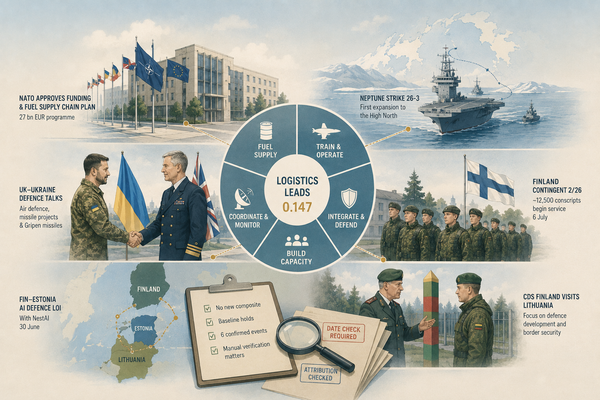
| Logistics | 0.147 |
| Info/Cyber | 0.019 |
| Border/Air/Maritime | 0.088 |
Logistics has led for three consecutive snapshots: 0.174 → 0.199 → 0.147. The background is low and the trend is easing, but the sub-index remains the most loaded — and today's events confirm this substantively, not just numerically.
Six confirmed events
1. The NATO Council approved funding and the Fuel Supply Chain Plan
Source: NATO, confidence 0.95
Verification shows the decision was actually taken on 22 July — it reached the digest with a 12-day lag. The North Atlantic Council approved the 2027–2031 common funding plan (2027 ceiling up to €6.5 billion) and separately endorsed the €27 billion Fuel Supply Chain Capability Programme: modernising depots and pipelines, including new facilities in the eastern and south-eastern Alliance. Trade press describes it as the first large-scale rear-fuel-logistics modernisation since the Cold War, with full implementation running up to 30 years. Part of the resources goes directly to Ukraine support — NATO Security Assistance and Training and the joint NATO-Ukraine training centre.
BSM analysis: a direct hit on Logistics — and a direct explanation for why this sub-index has led three snapshots running, and not by chance. This is not an episode but a freshly approved five-year investment programme — structural load, not a transient one. At the same time, the 12-day publication lag is another instance of the freshness problem BSM has been documenting for weeks: a major institutional decision surfaces on a delay comparable to the interval between snapshots.
2. Neptune Strike 26-3: the first expansion into the High North
Source: NATO, 0.95
The activity ran 17–23 July, with STRIKFORNATO's official wrap-up published on 28 July — so this entry, too, is not today's news but a week old. Substantively it matters: the UK Carrier Strike Group (HMS Prince of Wales) and the Spanish Expeditionary Strike Group operated for the first time under a single NATO command in the Arctic and North Atlantic, alongside NISRF (NATO's ISR force) and the Arctic Sentry framework, with 14 contributing Allied nations. This is Neptune Strike's third 2026 iteration and the first held outside the Mediterranean.
BSM analysis: the geographic shift of Neptune Strike from the Mediterranean to the Arctic and North Atlantic signals where NATO is moving its strategic centre of gravity. For the Baltic region this is adjacent rather than direct news, but it lines up with the parallel reinforcement of Baltic Sentry and Arctic Sentry within the same operational window.
3. Ukraine–UK: air defence, anti-ballistic projects and Meteor missiles for Gripen
Source: Ukraine MoD, 0.92
This one is genuinely fresh — Ukraine's acting Defence Minister Yevhenii Khmara and Commander-in-Chief Drapatyi met UK Chief of the Defence Staff Air Chief Marshal Sir Richard Knighton on 1 August. Topics included strengthening air defence, anti-ballistic projects, Meteor missiles for Gripen aircraft, and counter-Shahed systems — potentially financed from frozen Russian assets.
BSM analysis: a natural continuation of the "combat experience for technology" line BSM has tracked since spring. The Gripen detail is notable in context: this is not just supply but deeper technical integration around a specific platform.
4. Finland: Contingent 2/26 — ~12,500 conscripts
Source: 0.9
Service began on 6 July — meaning the digest surfaced a nearly month-old entry for the second time in a week (the same event appeared in the 31 July top five). This is no longer isolated recycling but a repeating pattern: the same event passing through the pipeline twice as "new."
5. Finland+Estonia+NestAI: defence-AI Letter of Intent
Source: 0.9
Likewise, the agreement was signed on 30 June and has also resurfaced in the digest before (it appeared on 31 July too). A second instance of duplication within the same week.
6. Commander of the Finnish Defence Forces visits Lithuania — with an important correction
Source: 0.9
Verification found an attribution error in the raw feed. The digest labelled this "Commander of Finnish SOF," but according to official Puolustusvoimat reporting, it was General Janne Jaakkola, Commander of the Finnish Defence Forces overall (Chief of Defence), not specifically the special-operations commander, who visited Lithuania on 30–31 July. The programme covered Lithuania's defence-capability development, a briefing on the new Lithuanian long-range autonomous UAV unit, a visit to the Lithuanian-Belarusian border (Padvarionys border post, hosted by Lithuania's State Border Guard commander), and a commemoration ceremony at Medininkai.
BSM analysis: the visit's actual rank — the country's top military officer, not a single-branch commander — meaningfully raises the event's weight compared with how the digest described it. It is also a useful illustration of why editorial verification remains necessary even on a "quiet" day: automated attribution confused the seniority and role, and errors of this kind, over time, distort Force Posture more than stale dates distort freshness.
What this day says about the pipeline itself
WF3 is blocked by quota — no new deterministic coefficients today, only a qualitative read against baseline. Combined with the fact that at least four of six significant events turned out older than their claimed date (the Fuel Supply Chain Plan by 12 days, Neptune Strike by a week, Contingent 2/26 and the NestAI LOI recurring for the second time in a week), and one carried a role-attribution error, this is another cross-section of the same freshness-and-accuracy crisis BSM has been documenting since July. The difference today is that it showed up not in a sharp index but in a quiet, institutional stream where there's no drama to prompt an independent date check.
One methodological caveat: Telegram channels and war_context were not included in the sample, so 24-hour coverage is incomplete — the absence of Border/Air/Maritime and Info/Cyber signals may be a visibility gap rather than an absence of events.
The Baltic and Finnish accent of the day
Finland appears in four of the six significant events — today the pipeline is structurally Finland-centric. Together these events form a coherent picture: NestAI (technological integration), Contingent 2/26 (reserve generation), Neptune Strike (participation in flank exercises), Jaakkola's visit to Lithuania (bilateral coordination and the Lithuanian-Belarusian border). No single event is a breakthrough, but the sum continues the slow, steady North-Baltic integration trend BSM has been tracking — a trend, not a spike.
Bottom line
A day without a new number is not a day without a signal. Logistics leads the baseline for a reason: NATO just approved a €27 billion programme specifically for fuel logistics. But the day also showed that manual verification is needed even when the pipeline generates no alarms: a role-attribution error and the repeat recycling of two week-old entries are things no composite figure will ever show.
Baltic Security Monitor (osint-baltic.com) — an analytical publication on security along NATO's north-eastern flank. This review is qualitative: no new deterministic OSINT coefficients were computed, as WF3 was blocked by quota.