From Sanctions List to Helicopter Boarding: The EU Tests a Physical-Control Model for Russia's Shadow Fleet

Baltic Security Monitor | Material Update Snapshot: 3 August 2026, 08:00
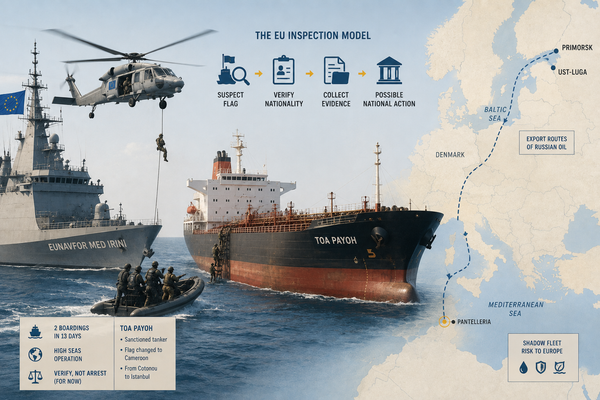
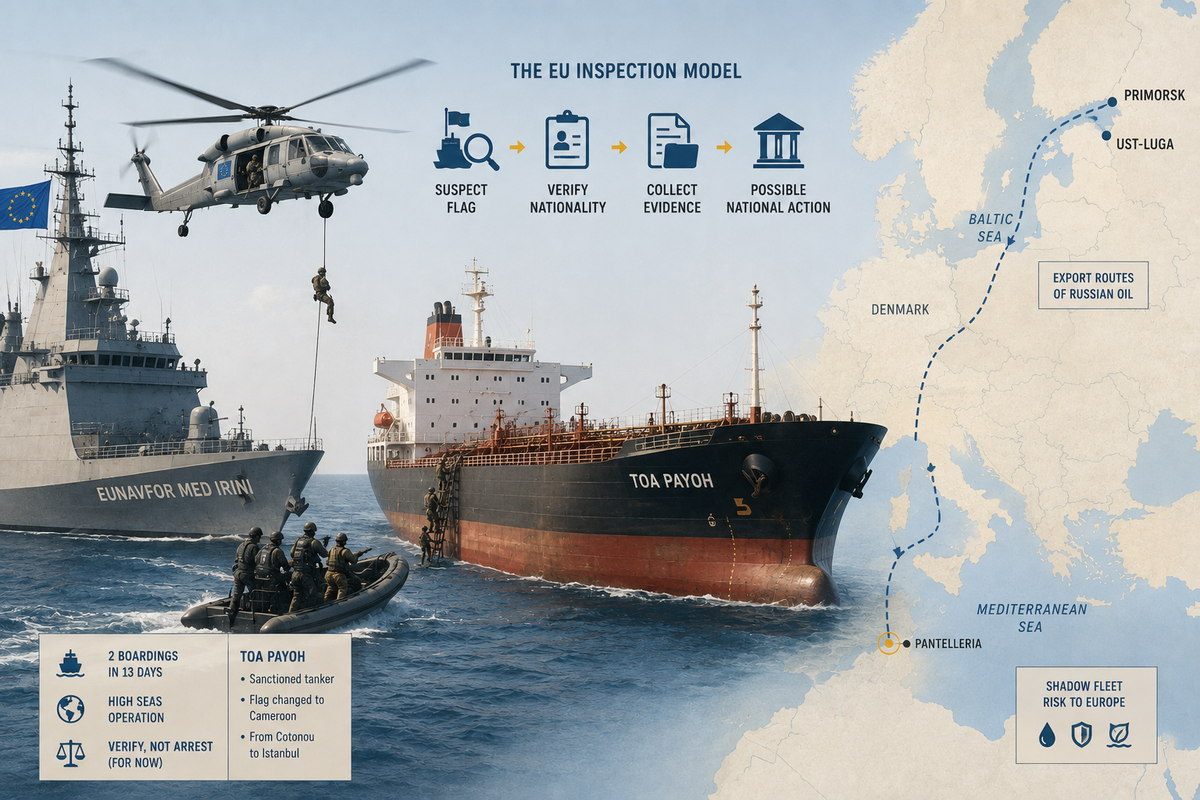
Two helicopter boardings of shadow-fleet tankers in thirteen days is no longer an incident — it's a method. The Italian flagship of EUNAVFOR MED Irini stopped and inspected the tanker Toa Payoh on the morning of 2 August, 4,000 km from the Baltic, in the Mediterranean. But the legal construction the EU is testing — questionable flag, then a nationality check, then evidence collection, then possible national detention downstream — travels to any sea where Cameroon- or Gabon-flagged vessels sail. Including the one that carries all the export traffic out of Ust-Luga and Primorsk.
What happened
On the morning of 2 August, the Italian ship Thaon di Revel, flagship of the EU's EUNAVFOR MED Irini operation, stopped the tanker Toa Payoh west of Pantelleria, between Sicily and Tunisia, in international waters. The vessel, under EU, US, UK, Swiss and Canadian sanctions over alleged involvement in transporting Russian petroleum products, was sailing from the Beninese port of Cotonou to Istanbul; it had switched to a Cameroonian flag only a week before the voyage.
The captain initially refused to cooperate with the boarding team. An Italian inter-agency team was flown across by helicopter; the operation, backed by a Greek vessel and a Polish maritime patrol aircraft, lasted about two hours and concluded without incident. Irini's mandate, Article 110 of the UN Convention on the Law of the Sea, allows verification of a vessel's nationality and flag but not seizure. The Toa Payoh was not detained; the documents gathered were passed to Italian and EU authorities for possible follow-up national action.
This is the second such boarding in under two weeks: on 20 July, Irini forces had already boarded the tanker MV South Star over the same suspicion of a false flag.
What changed
Until now, European pressure on the shadow fleet has mostly taken the form of sanctions lists, port restrictions and isolated detentions in territorial waters. A second forcible boarding on the high seas establishes a practice that is now repeating: questionable flag, then nationality verification, then evidence collection, then possible national detention at the next stage.
It is particularly notable that Europe is specifically targeting vessels flying the Cameroonian flag: EU pressure has already forced Cameroon to strike dozens of suspect tankers from its registry, and the Toa Payoh switched to that flag literally a week before its voyage, meaning the nationality check is aimed squarely at the vulnerable point in the evasion scheme.
BSM analysis: the operation's legal ceiling is the point. Irini can verify but not arrest; this is a deliberately limited but repeatable tool, built not for a one-off effect but to accumulate an evidence base and raise the scheme's operating costs — flag changes, re-insurance, rerouting. The gap between "inspect" and "detain" remains the main structural constraint on European shadow-fleet policy.
The Baltic dimension
Russia's primary export terminals, Ust-Luga and Primorsk, sit on the Baltic Sea, and a large share of the sanctioned fleet transits the Danish Straits and along the European coastline. The Pantelleria operation creates a precedent applicable to the Baltic: European states can verify not just a vessel's cargo but the legitimacy of its flag, registration and insurance, especially relevant for aging tankers with opaque ownership that pose both a sanctions and an environmental risk.
The Toa Payoh inspection alone does not mean similar operations will automatically begin in the Gulf of Finland or the Danish Straits: that would require an appropriate legal mandate, coordination among coastal states, and clear rules of engagement, none of which has been announced for the Baltic so far. 🟡
Likely consequences
- European states will more often challenge tankers' fictitious or questionable registration, rather than limiting scrutiny to the oil's origin.
- Cameroon and other open registries will face additional pressure to strike vessels linked to Russian exports.
- Denmark, Sweden, Finland and the Baltic states may draw on this practice when designing a tighter inspection regime for vessels leaving Russian ports. 🟡
- Shadow-fleet operators will face rising costs for flag changes, insurance and rerouting.
- The gap between inspection and immediate detention will remain the main limit on European policy until a new legal mandate emerges.
Bottom line
Twice in thirteen days, the EU has performed the same gesture: a helicopter, a boarding team, two hours of paperwork, no arrest. The repetition, not the single incident, is the message: Europe is testing a procedure it can later scale. The question for the Baltic isn't whether the model works in the Mediterranean, it already does. It's when the Baltic's coastal states agree on a mandate that turns an inspection into a detention closer to Ust-Luga than to Pantelleria.
Baltic Security Monitor (osint-baltic.com) — an analytical publication on security along NATO's north-eastern flank. All OSINT coefficients are computed by an automated open-source indexing system.