Twenty-Seven Ballistic Missiles, One Intercept: The New Strike Data Marks the Limit of Ukraine's Air Defence — and the Exposure Behind It

Baltic Security Monitor | Material Update (revised 14:00) Snapshot: 1 August 2026, 14:00
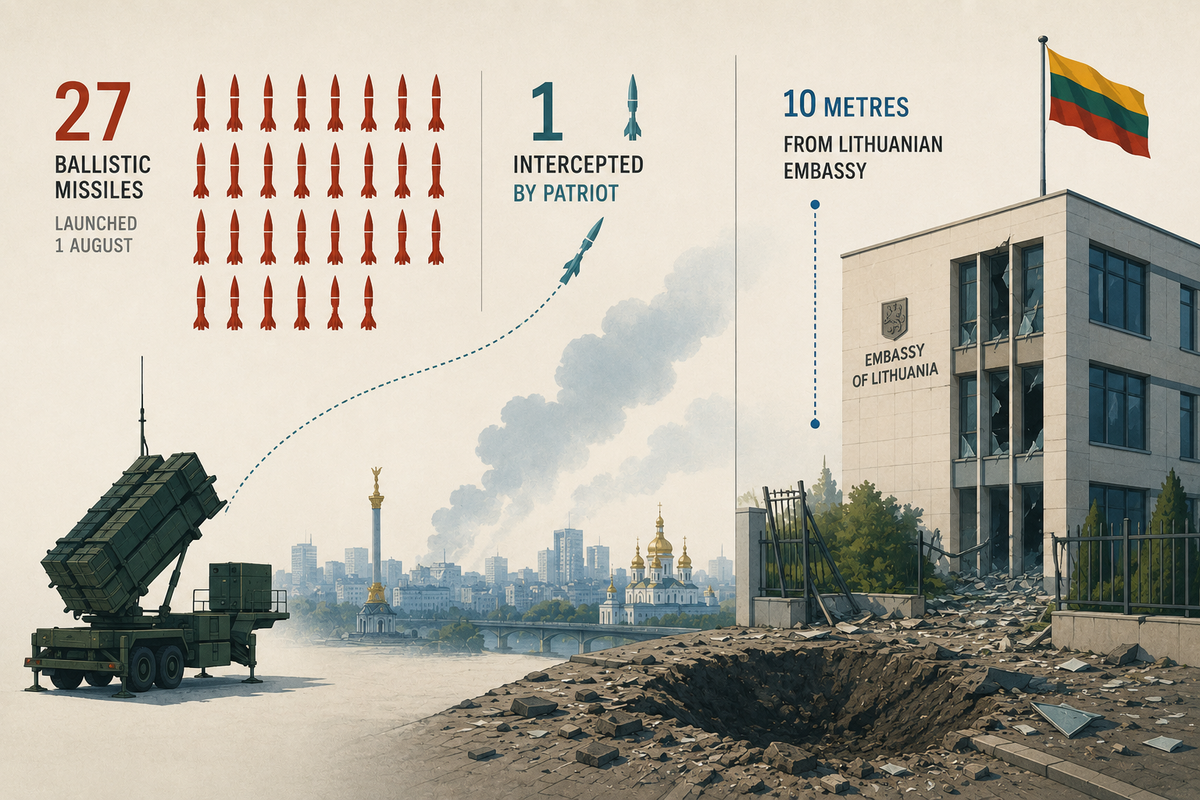
This morning the headline signal seemed to be tempo — a second mass salvo within 48 hours. The afternoon data shifted the emphasis: the story is not just frequency but outcome. Of the 27 ballistic missiles Russia fired overnight, one was intercepted. Not through tactical failure — simply because, in President Zelensky's words, there are no missiles left for the Patriots. That means Ukraine's air defence, in its current state, cannot serve as an outer protective layer for NATO's eastern flank. And on the same night, two Russian missiles landed 10 and 150 metres from the embassy of Lithuania — an Alliance member state.
What the afternoon data showed
According to Ukrainian officials, Russia fired 35 missiles overnight — 27 of them ballistic, Iskander-type — along with 185 attack drones; air defence tracked 358 aerial weapons in total. Kyiv was the primary target, with strikes also reported in Dnipropetrovsk, Sumy, Kharkiv and Poltava oblasts.
One ballistic missile was intercepted. Zelensky's explanation was unusually blunt: it was shot down "simply because there are no missiles for the Patriots" — and it is precisely this interceptor shortage, he argued, that encourages Russia to mount such strikes. His appeal to partners: these capabilities are needed "not somewhere in stockpiles for hypothetical scenarios, but here and now."
The confirmed toll in Kyiv: at least nine killed and around 30 injured, with fires and destruction across five to seven districts. Among the damaged sites was the Kyivmedspetstrans medical transport depot — five ambulances destroyed and roughly 20 more damaged.
BSM analysis: a 1-in-27 ratio is not "a bad night for air defence" — it is the arithmetic of an exhausted magazine. The morning thesis about strike tempo now has a harder formulation: Russia is not merely compressing the intervals between salvos; it has assembled a salvo that almost entirely exceeds Ukraine's current anti-ballistic intercept capacity. From here, this is no longer a question of tactics but of interceptor logistics.
Ten metres from the embassy: the Baltic dimension
Lithuania's foreign ministry confirmed that two missiles came down next to its Kyiv embassy overnight — one roughly 10 metres away, the other about 150. Windows were shattered, solar collectors damaged, the yard strewn with debris; no staff were hurt. Foreign Minister Kęstutis Budrys announced that Vilnius would summon Russia's representative the same day in protest, adding that what might actually stop the aggression is not a note but continued support for Ukraine, greater resilience, and sanctions pressure. Ukraine's Foreign Minister Sybiha responded with solidarity, invoking the Vienna Convention.
There is no basis to conclude the diplomatic mission was deliberately targeted. But for the Baltic region the incident matters for a different reason: a NATO member state's facility physically sat inside the impact zone of a Russian mass strike. The consequences of the campaign are no longer indirect.
BSM analysis: two summonses of Russian representatives in two Alliance capitals within two days — Warsaw on 31 July (a formal note over the Kh-101), Vilnius on 1 August (a protest over the embassy). A pattern is forming in which every mass salvo against Ukraine generates a formal diplomatic episode inside a NATO state. The process is cumulative: each new incident lands on top of the previous notes, and the threshold for Article 4 consultations drops with every repetition. 🟡
Why this changes the regional assessment
The regional picture is now defined by the combination of three factors: a dense salvo series + an exceptionally high ballistic share + a critically low intercept rate.
- Ukraine's "outer layer" is effectively transparent to ballistic missiles. The more missiles reach western and central Ukraine, the higher the risk of debris, errant trajectories, and repeat incursions into the airspace of Poland, Romania or other neighbours. 🟡
- Prioritisation becomes unavoidable. If the ballistic share stays high, Ukraine will be forced to concentrate its remaining assets on Kyiv, military sites and critical infrastructure — at the cost of coverage elsewhere. 🟡
- A new endurance metric for the flank. Not the number of available batteries, but the interceptor stock for several consecutive nights. The night of 1 August showed that this stock can hit zero mid-campaign.
- Vilnius's political vector. The embassy damage will likely push Lithuania to press allies — at EU and NATO level — for immediate transfers of ready interceptors to Ukraine rather than long-horizon production promises. 🟡
The context that hasn't gone anywhere: the licence whiplash
The afternoon data sharpens the morning's political storyline. On 31 July — hours before the salvo — Trump told a Camp David Cabinet meeting that the US "has not agreed" to grant Ukraine licences to produce Patriot interceptors, calling the technology "a hard thing to give away" and walking back a promise confirmed at the 28 July Oval Office meeting and first made publicly at the NATO summit. Hours later, Ukrainian air defence intercepted one ballistic missile out of twenty-seven — simply because there were no missiles for the Patriots.
Rarely is the causal chain between a political decision and its price demonstrated this visibly, on this short a timeline.
Bottom line
In the morning, the count was in hours between salvos. By afternoon, the more precise count emerged: twenty-seven to one. An air defence without interceptors is not a weakened shield — it is an absent one; and behind it, ten metres from the latest crater, stands the embassy of a NATO state. The eastern flank has just received its most precise measure of vulnerability — and it is denominated not in kilometres, but in PAC-3 rounds in storage.
Baltic Security Monitor (osint-baltic.com) — an analytical publication on security along NATO's north-eastern flank. All OSINT coefficients are computed by an automated open-source indexing system.